

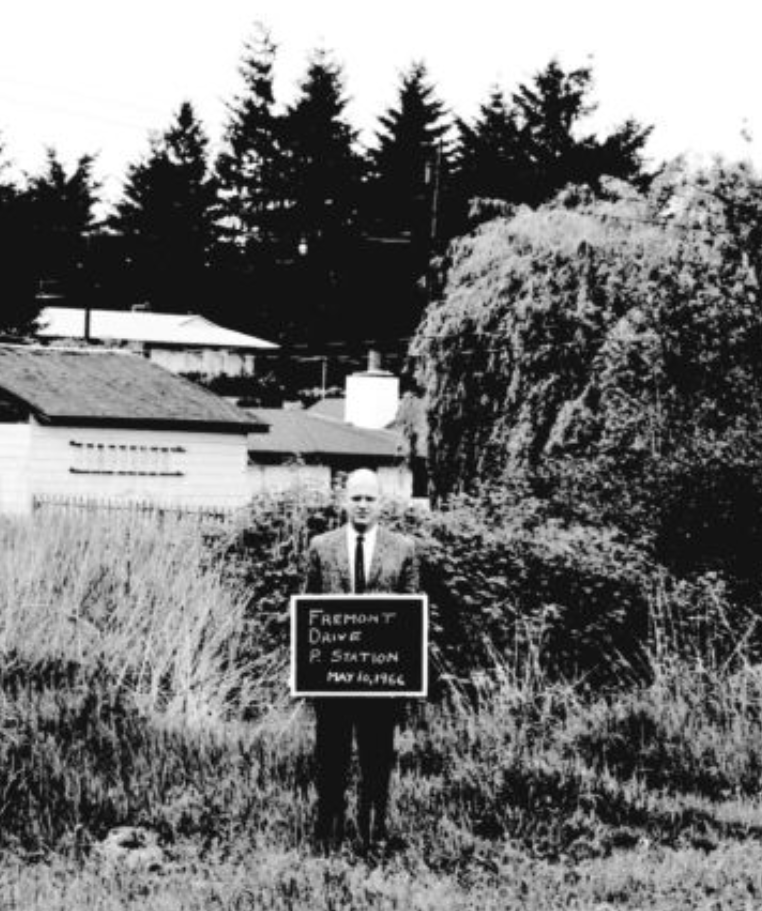
Man holding a sign that says Fremont Drive pump station 1966, A2012-005
On Rocky Butte, the drainage structures at the road edge are called runnels. Built in 1939 by the Works Progress Administration they are constructed of stone which was quarried from the butte itself. Using hand tools craftsmen shaped many thousands of linear feet to be set. This stormwater structure consists of two stone curbs with a stone bottom approximately one foot wide, and drop inlets located at various intervals along the runnel. The drain inlets range from 2 feet wide by 4 feet long to 4 feet wide by 10 feet long. Originally, all of the drain inlets were covered with flat stone covers but almost all of these have been replaced. The drop inlet structures are also made of stone and can handle a very large capacity of surface water. The underground stone channels are lined with cement pipes and carry the water down to the Fremont Drive Pump Station and beyond!
Civilizations using runnel systems date back to ancient Greece and it is fun to look for similarities in the ancient stone stormwater system and Rocky Butte’s runnels. Effective design finds a way of replicating, and effective features of water control are present in both, as is hand hewed stonework and covered pipes. Hopefully in a few thousand years Rocky Butte’s runnels will still be catching rain.
runnel (n.)
“rivulet, small stream of water,” an alteration (by influence of run) the Old English noun ryne/yrn (early Middle English rine) meant “a flowing, a course, a watercourse.
National Registry of Historic Places: https://npgallery.nps.gov/pdfhost/docs/NRHP/Text/91001550.pdf

Runnel and stone inlet, Rocky Butte Drive west. 2024

Stone inlet and cement pipe, Rocky Butte Drive west. 2024

Stone inlet with no cover, Rocky Butte Drive west. 2024

Runnel and wall, Rocky Butte Drive west. 2024

Stone inlet with replaced cover, Rocky Butte Drive west. 2024

Runnel chute Rocky Butte Drive east, 2024

Ancient storm water runnel at Phaistos, Greece.
Angelakis, A. N., Koutsoyiannis, D., & Tchobanoglous, G. (2005). Urban wastewater and stormwater technologies in Ancient Greece. Water Research, 39(1), 210–220. https://doi.org/10.1016/j.watres.2004.08.033

Runnel system from ancient Athens.
Angelakis, A. N., Koutsoyiannis, D., & Tchobanoglous, G. (2005). Urban wastewater and stormwater technologies in Ancient Greece. Water Research, 39(1), 210–220. https://doi.org/10.1016/j.watres.2004.08.033

Ancient ceramic sewer pipe in the gymnasium at Amphipolis, Greece.
Angelakis, A. N., Koutsoyiannis, D., & Tchobanoglous, G. (2005). Urban wastewater and stormwater technologies in Ancient Greece. Water Research, 39(1), 210–220. https://doi.org/10.1016/j.watres.2004.08.033

The end part of runnel system in ancient Knossos, Greece.
Angelakis, A. N., Koutsoyiannis, D., & Tchobanoglous, G. (2005). Urban wastewater and stormwater technologies in Ancient Greece. Water Research, 39(1), 210–220. https://doi.org/10.1016/j.watres.2004.08.033
 Rocky Butte Preservation Society
Leave a comment